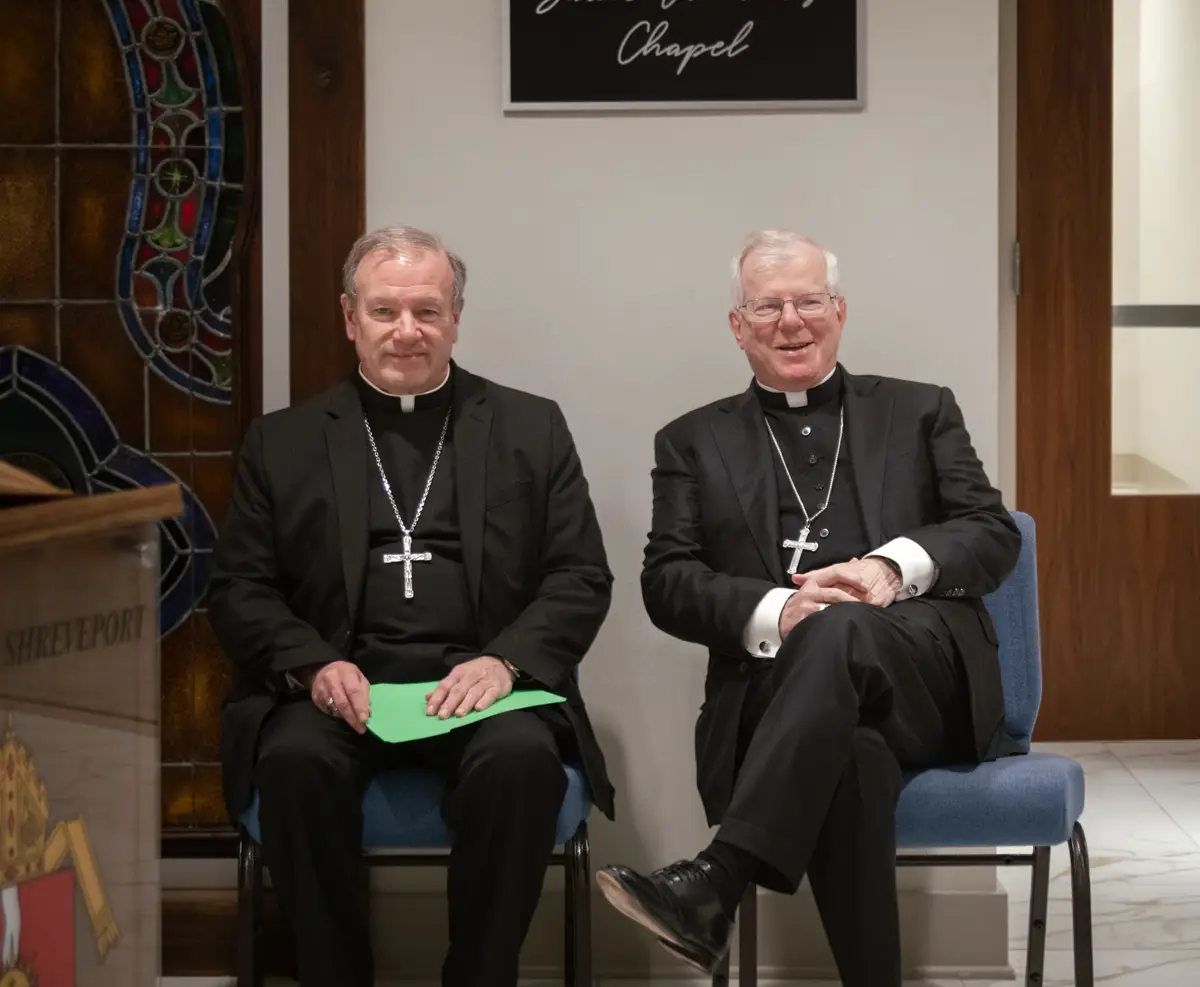
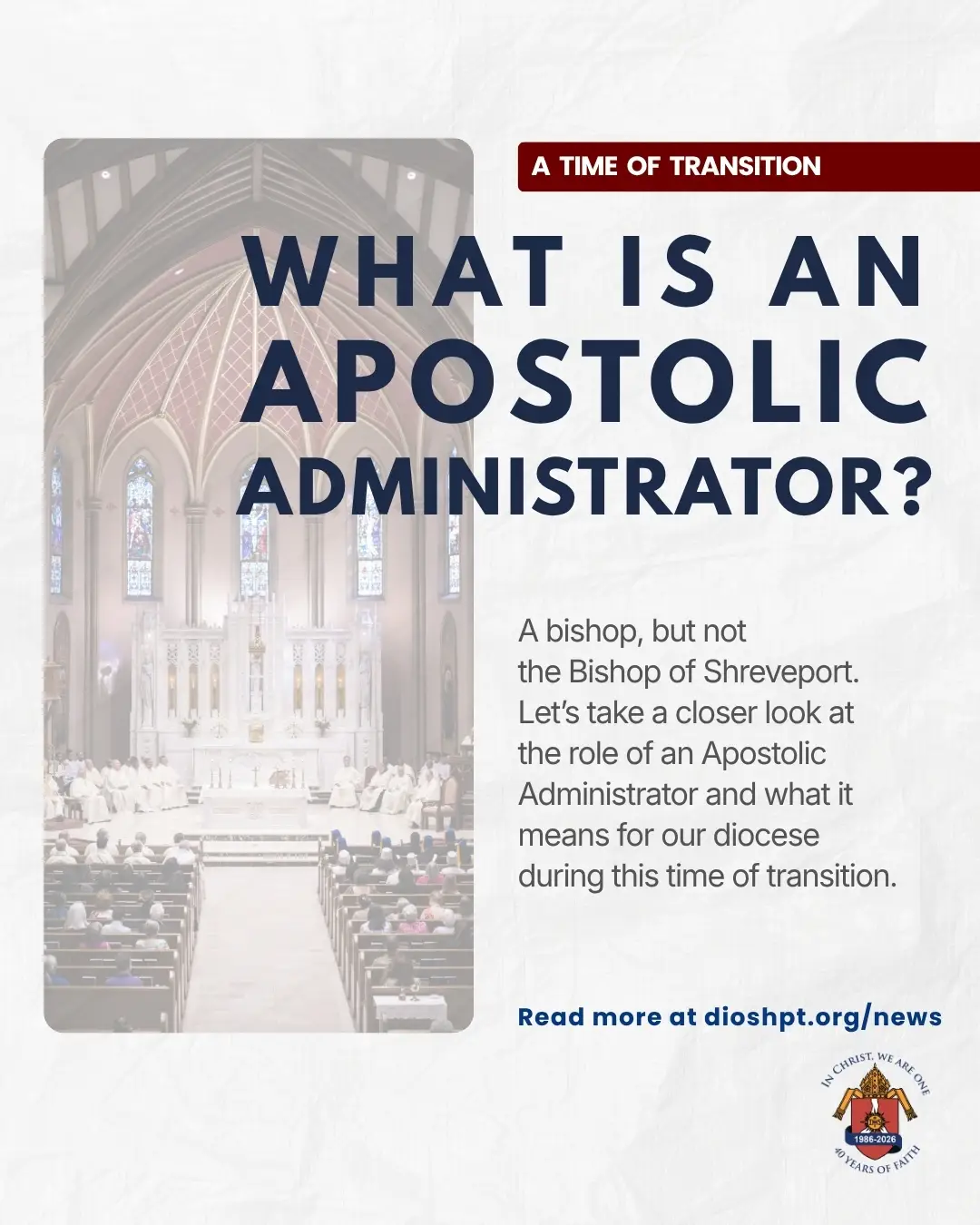
The Diocese of Shreveport is currently in a time of transition. Following the retirement of Bishop Emeritus Francis I. Malone, the Holy See appointed Bishop Robert W. Marshall, Jr., the Bishop of Alexandria, as the Apostolic Administrator of the Diocese of Shreveport.
That title might be unfamiliar, and it has understandably raised a few questions. Here is the simplest way to understand our current situation:
- Bishop Francis I. Malone is our Bishop Emeritus. In Latin, “emeritus” means “having served one’s time.”
- Bishop Robert W. Marshall, Jr. is our Apostolic Administrator, entrusted with governing our diocese during this transition.
- Our next Bishop of Shreveport has not yet been appointed.
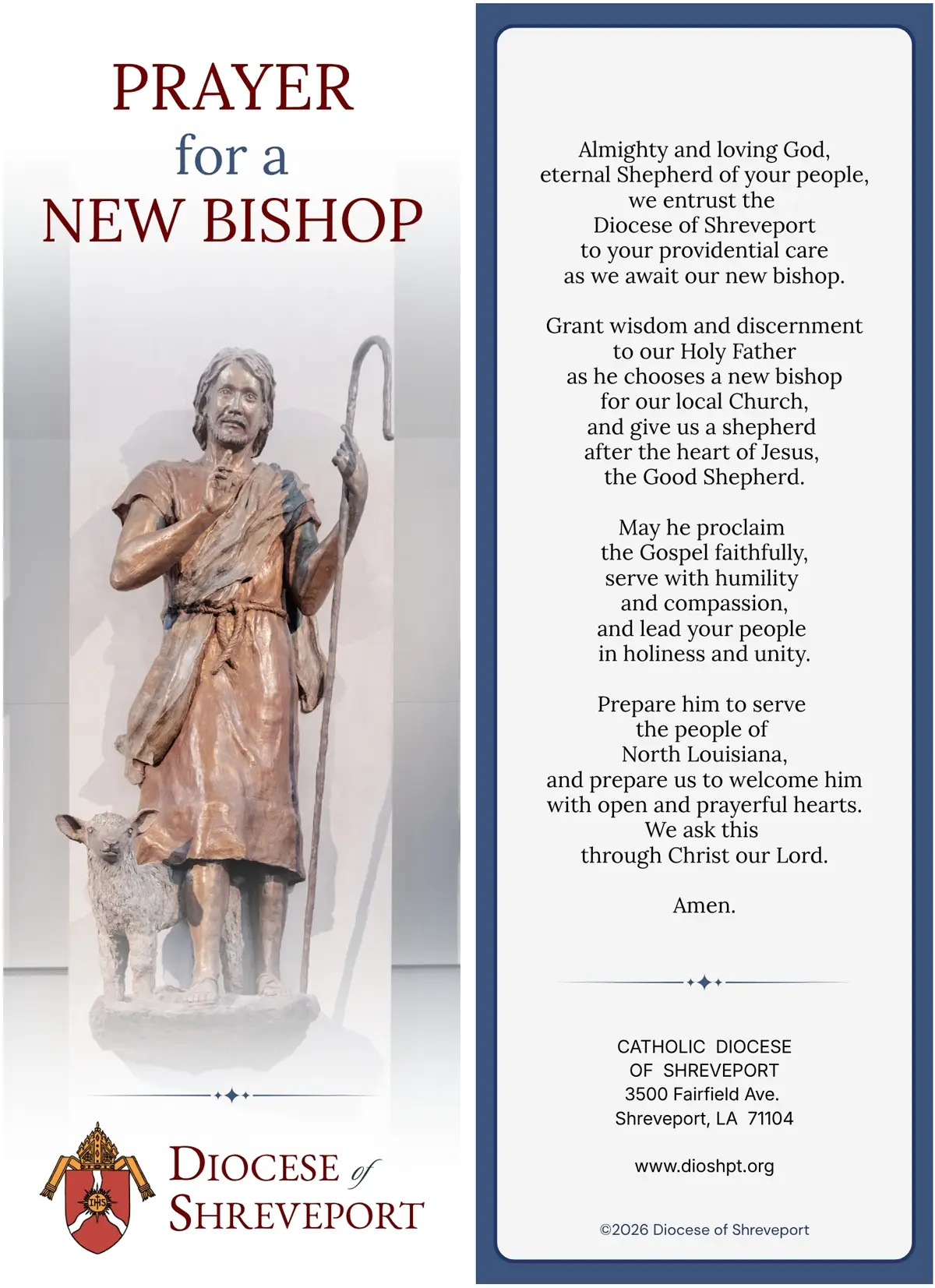
In Church terminology, our diocese is currently sede vacante, a Latin phrase meaning “the see is vacant.” The office of Bishop of Shreveport is presently vacant while we await our next bishop, who will be appointed by the Holy Father.
Why is this transition different from previous ones?
You might remember previous times when the diocese was led by a Diocesan Administrator. This time, the Holy See appointed an Apostolic Administrator instead. Here is the difference:
- A Diocesan Administrator is a priest ordinarily elected by the diocesan College of Consultors to govern the diocese temporarily.
- An Apostolic Administrator – almost always a bishop – is appointed directly by the Holy See to oversee a diocese during a transition.
Bishop Marshall has been given authority to govern Shreveport, but his assignment is temporary. The Decree from the Vatican Dicastery for Bishops specifies that his tenure as Apostolic Administrator will end when the next Bishop of Shreveport takes office. Bishop Marshall remains the Bishop of Alexandria. Because he is already a bishop, it’s easy to see why some might assume he is our new diocesan bishop. However, he is in fact temporarily serving as a bridge between Bishop Malone and our future shepherd.
What does an Apostolic Administrator do?
Think of the administrator as a temporary shepherd. Bishop Marshall oversees the ordinary life of the diocese, ensuring our pastoral, administrative, financial, and personnel needs are met so the Church’s mission can continue.
Does he have the same authority as a diocesan bishop? In many areas, yes. But canon law follows an important principle during a vacant see: “nothing is to be altered.” This means necessary decisions can be made and normal work continues, but major long-term changes are left for the new bishop. This protects both continuity and stability.
What happens now?
There is no set timeline for when the Holy Father will appoint our new bishop. Until then, Bishop Marshall will continue serving both Alexandria and Shreveport simultaneously.
For most Catholics in North Louisiana, parish life continues as normal. Masses are celebrated, sacraments are administered, and our schools and ministries continue their work.
We’re incredibly grateful to Bishop Marshall for taking on this additional responsibility. Most importantly, we ask you to continue praying for Bishop Marshall, for our diocese, and for the man who will eventually be called to serve as our next shepherd.
Summary:
- Bishop Francis I. Malone is now the Bishop Emeritus following his retirement.
- Bishop Robert W. Marshall, Jr. is temporarily leading our diocese as the Apostolic Administrator.
- Bishop Marshall is not the new Bishop of Shreveport, as he remains the Bishop of Alexandria.
- Our diocese is sede vacante (the see is vacant), and we are awaiting the Holy Father’s appointment of our next bishop.